
First Time Abatement Is Changing: What Doctors Should Know
Read to the end for a Special Trivia Question!
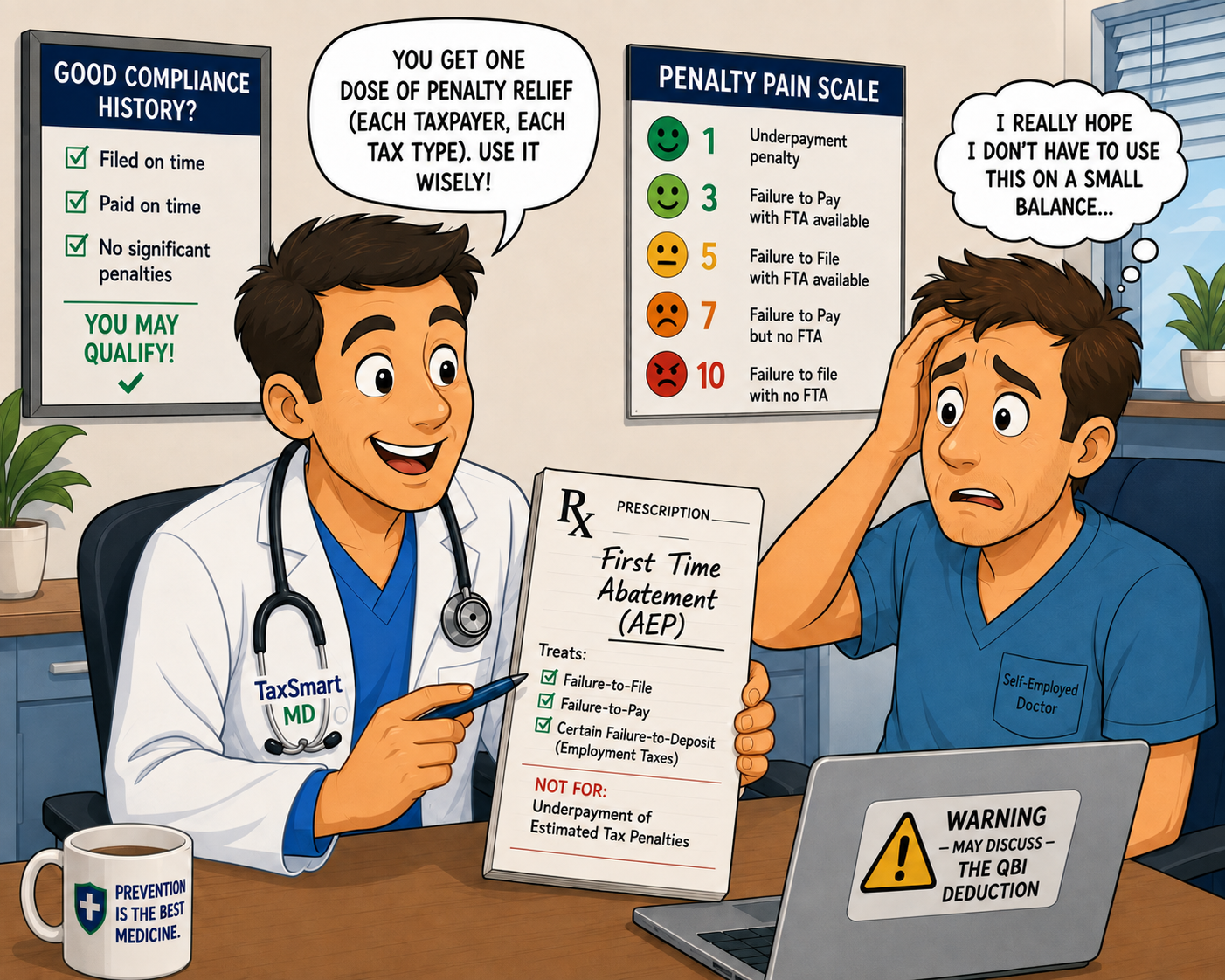
Ask your tax advisor if penalty relief is right for you.
Doctors who pay a tax penalty often assume there is nothing they can do about it. Fortunately, the IRS has historically offered a relatively generous administrative waiver called First Time Abatement (FTA).
Beginning in 2026, the IRS is transitioning FTA to a new system called the Automatic Exemption from Penalty (AEP). The underlying lesson is the same: if you have a good compliance history, one mistake may not have to cost you thousands of dollars.
Who Qualifies?
Under the traditional First Time Abatement rules, taxpayers generally qualify if they have a clean compliance history for the prior three years. In practical terms, you generally need to have filed the required returns and avoided significant penalties during that period.
AEP uses a similar concept. For an individual taxpayer, the IRS looks for three prior years of timely filing and payment compliance. If you qualify, the relief is applied automatically rather than requiring you to call the IRS and ask for it.
Which Penalties Can Be Removed?
FTA and AEP can generally provide relief from penalties such as:
Failure to file
Failure to pay
Certain failure-to-deposit penalties for businesses
One very important exception is the underpayment of estimated tax penalty.
If you are a 1099 physician and did not make sufficient quarterly estimated payments, FTA is not a magic eraser for that penalty. Estimated tax penalties have their own rules and potential exceptions.
What Changed With AEP?
Historically, First Time Abatement usually required you or your tax professional to contact the IRS after a penalty was assessed and request relief.
The IRS began transitioning to Automatic Exemption from Penalty in Summer 2026. Under AEP, qualifying taxpayers generally do not need to request relief. The IRS identifies the clean compliance history during processing and prevents eligible penalties from being assessed in the first place.
AEP begins with eligible 2025 income tax returns and 2026 quarterly returns. FTA is being phased out and will be replaced by AEP for eligible original returns with due dates on or after January 1, 2027.
That sounds like an improvement—and mostly it is. But it creates an important planning issue.
Don't Waste Your One Free Pass on a Small Balance Due
Suppose you are a self-employed physician who normally pays $100,000 or more per year in federal tax.
You prepare your return and discover that you owe an additional $2,000 on April 15. If you otherwise qualify for AEP, the IRS may automatically waive the failure-to-pay penalty associated with that balance.
Great, right? Maybe not.
You have now used your clean-history administrative relief on a relatively small mistake. It would have been much more valuable if you had needed it in a future year involving a much larger penalty.
This is another reason I like 1099 physicians to be conservative with their April 15 payment. If your tax projection indicates that you need to make a first-quarter estimated payment for the new year anyway, consider putting some or all of that money toward an extension payment for the prior year before April 15.
If the return ultimately shows a higher tax liability than expected, the money is already there to cover it.
If you overpay, you can generally elect on the return to have the excess applied toward the following year's estimated taxes rather than receiving it as a refund.
Think of it as inexpensive insurance against unexpectedly using AEP on a small April balance.
TaxSmart Takeaway
First Time Abatement and AEP are valuable safety nets. They shouldn't be part of your routine tax strategy.
File your extensions on time. File the eventual tax return on time. Make accurate tax projections during the year. And make sure you have paid enough by April 15—particularly if you have substantial 1099 income.
You never know when you might actually need that clean compliance history. Penalty relief is valuable precisely because you don't get unlimited opportunities to use it. Good tax planning doesn't just minimize today's penalty—it preserves your options for the future.
Special Trivia Question!
If you are due a tax refund on your individual return (1040), and you miss the filing deadline, how much is the failure to file penalty?
A. Minimum of $525
B. 0.5% of your total tax liability per month, maxing out at 5% (10 months)
C. 1% of your total tax liability per month, maxing out at 5% (5 months)
D. $0
Click here for the answer!