
Why Does My Tax Professional Charge So Much? A Physician’s Guide to Lowering Your Tax Prep Bill
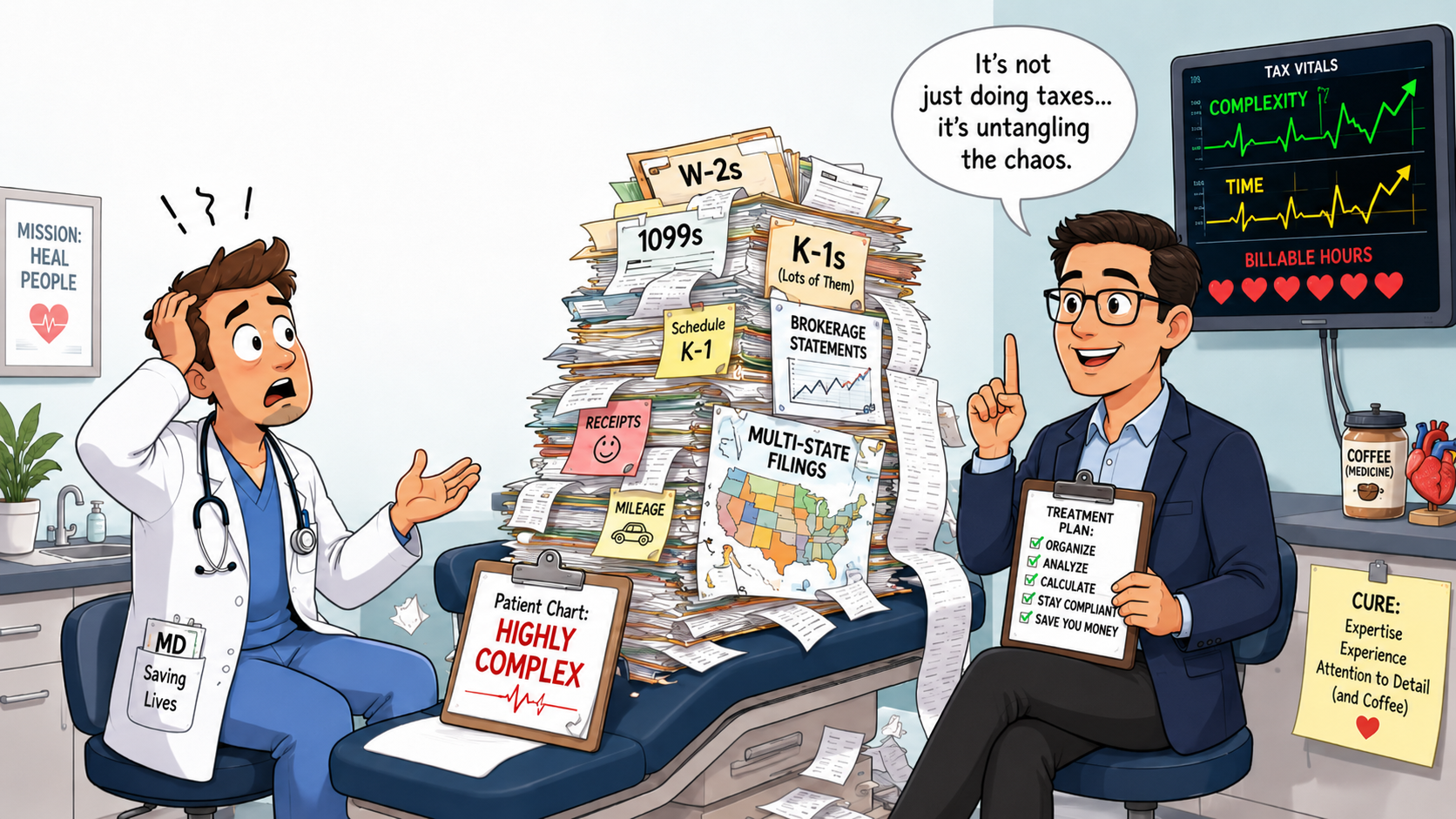
A critical tax situation can be expensive in the beginning but less costly after it stabilizes
Physicians are used to complicated billing.
You know the drill: the 99214 that turned into a prior-auth saga, the “quick question” portal message that required a chart review, and the discharge summary that somehow took longer than the admission.
Tax preparation has its own version of this.
A tax return may look like a simple stack of forms, but behind the scenes your tax professional is triaging documents, reconciling inconsistent numbers, chasing missing information, reviewing state-specific rules, checking software imports, and trying to prevent the tax equivalent of a retained sponge.
So if you’ve ever wondered, “Why does my tax professional charge so much?” or “Why did my fee go up this year?” this post is for you.
The short answer is this: complexity takes time, and during tax season, time is the scarcest resource in the building.
The good news? There are practical ways to make your return easier, cleaner, and sometimes less expensive to prepare.
Let’s round.
1. Consolidate Your Accounts and Income Sources
Every extra tax form is another item on the problem list.
A 1099-INT from a forgotten savings account with $3 of interest may not feel like a big deal. But your preparer still has to receive it, identify it, enter it, verify it, and make sure it doesn’t create another reporting issue.
“Doesn’t the software just read the PDF?”
Sometimes. But software imports are not magic. They’re more like a first-year med student presenting on rounds: helpful, enthusiastic, and occasionally very wrong. A human still has to verify that the numbers landed in the right place.
If you have multiple brokerage accounts, old savings accounts, forgotten HSAs, crypto platforms, or small investment accounts you no longer need, consider consolidating. Fewer accounts can mean fewer forms, fewer surprises, and a cleaner return.
TaxSmart move: If an account is not serving a clear purpose, ask whether it is worth the extra paperwork.
2. Limit the Number of States in Your Tax Chart
Multi-state tax returns are where simple returns go to develop complications.
This is especially relevant for physicians. Locums work, telemedicine, moonlighting, remote consulting, expert witness work, and passive investments can all create income sourced to different states. Each state has its own rules. Some have filing thresholds. Some do not make life easy. Some require apportionment. Some require withholding. Some produce K-1s that allocate $73 of income to a state you have not visited since residency.
For doctors, this is actionable. If you do locum tenens, consider whether it is worth working in a new state for one shift or one weekend. That Christmas-weekend assignment may pay well, but if it triggers another state return, another medical license, another DEA registration, and another layer of tax prep, the net benefit may be less impressive. Your family may also appreciate not losing you to a holiday shift in a state where you otherwise have no reason to be.
Passive investments can create the same issue. A fund may generate income in multiple states, even if your actual dollar amount is small. Your preparer may still need to review the state sourcing details, determine filing requirements, and compare the income to each state’s thresholds.
A $50,000 investment that earns $5,000 sounds like a 10% return. But if it adds $1,500 of tax filing cost, the after-compliance return looks much less exciting.
TaxSmart move: Before adding locums work or multi-state investments, ask: “Will this create another filing obligation?”
3. Keep Good Records for Business and Rental Expenses
Doctors understand documentation.
“If it wasn’t documented, it didn’t happen” applies in tax, too.
If you have a side business, medical consulting income, expert witness work, rental property, or a professional corporation, clean records make a big difference. Ideally, you should track income and expenses throughout the year rather than reconstruct everything in March from a pile of statements and a vague sense that “Amazon was mostly business.”
A dedicated business bank account and credit card help. So does accounting software. At TaxSmart MD, I provide Xero to clients when it makes sense because real-time bookkeeping is much easier than financial archaeology.
Try to categorize expenses in a way that maps to the tax return. For a Schedule C business, that means categories like advertising, office expense, supplies, insurance, legal and professional fees, meals, travel, and continuing education. For rentals, that means categories like repairs, supplies, utilities, insurance, property taxes, mortgage interest, HOA dues, management fees, travel, and depreciation-related improvements.
TaxSmart move: The best tax records are created during the year, not excavated after the fact.
4. Know What Information Your Preparer Needs
A good tax professional should know what questions to ask. But the smoother you make the intake process, the better.
Think of it like a consult note. If the note says, “Patient here for abdominal pain,” the consultant has to do a lot of digging. If it includes timing, location, labs, imaging, prior surgeries, medications, and the clinical question, the consult gets better and faster. Tax preparation works the same way.
If your preparer asks for:
W-2s,
1099s,
K-1s,
mortgage interest statements,
property tax amounts,
charitable giving records,
estimated tax payments,
business income and expenses,
rental property records,
childcare expenses,
HSA contributions,
retirement contributions,
state tax notices,
and prior-year carryovers,
try to provide the information in a complete and organized way.
TaxSmart move: Review last year’s return and organizer before tax season. It will remind you what information is likely needed again.
5. Be a Good Communicator
Virtual tax preparation can be efficient, but it depends on communication.
In an in-person appointment, your preparer can ask follow-up questions in real time. In a virtual process, those same questions may go through email or a portal. If you wait a week to reply, your preparer may have worked on dozens of other returns by then. That means they have to reopen the chart, remember the facts, re-review the issue, and get back into your return.
This is where tax season starts to feel like inpatient medicine. Every interruption creates handoff risk.
The best responses are timely and specific.
Instead of:
“That sounds right.”
Try:
“The $4,200 payment on March 15 was my 2024 fourth-quarter Colorado estimated tax payment. It was paid from our joint checking account.”
Instead of:
“Some of that was business.”
Try:
“Of the $3,000 conference trip, $2,200 was registration, airfare, and hotel for the CME conference. The remaining $800 was personal meals and sightseeing.”
TaxSmart move: Clear answers prevent follow-up questions, delays, and errors.
6. Don’t Procrastinate
Getting a tax professional during tax season is a lot like applying to medical school. The longer you wait, the more competitive it gets.
Many strong firms stop taking new clients during tax season. Others accept rush work but price accordingly. That is not because they are trying to be difficult. It is because March and April have a fixed number of hours, and every tax professional is trying to avoid practicing financial emergency medicine for two straight months.
If you want a thoughtful review, planning opportunities, and a smoother experience, start early. January and February are different from late March. There is more time, more flexibility, and less triage. If your documents are not all ready yet, that is fine. But get started. Upload what you have. Complete the organizer. Ask what is missing.
TaxSmart move: Early clients usually get a better process than last-minute clients.
7. Simplify Your Itemized Deductions
Itemized deductions are another area where small decisions can create extra work.
Charitable donations are a good example. Giving to 25 charities is generous, but it also means 25 receipts, 25 entries, and 25 chances for something to be missing. If you give frequently, consider whether a donor-advised fund or charitable bunching strategy could simplify your life and improve your tax planning.
Goodwill donations can also get messy. Ten small trips create ten receipts. One organized donation with a detailed list is much easier to document.
Medical expenses are another common pain point. For many physicians, federal medical expense deductions are not useful because expenses must exceed a percentage of income before they help. Some states have different rules, so they are not always irrelevant, but for high-income physicians, tracking every copay and pharmacy receipt may not move the needle.
If you do track medical expenses, provide a total by category rather than asking your preparer to add up a slew of receipts.
TaxSmart move: Simplify giving, summarize expenses, and avoid making your preparer do arithmetic that could have been done once during the year.
8. Review Your Tax Return Before Signing
I want clients to understand their tax returns before they sign and file. That is why I prepare a video review for every TaxSmart MD client.
This is not just for education. It is also quality control.
A drafted return is much easier to fix than a filed return. Correcting a return before filing may take a few minutes. Amending a return later can be more expensive, more annoying, and more likely to cause confusion with the IRS or state tax agencies.
If something looks wrong, say something. As a preparer, I am grateful when clients pay attention. If they are right, we prevented an error. If they are wrong, at least they understand the return better after we talk through it.
Doctors know this instinctively. A good catch before the procedure is much better than a complication afterward.
TaxSmart move: Review your return like it matters. Because it does.
9. Know When You Need Help
Not everyone needs to hire a tax professional. A straightforward W-2 return with a standard deduction may be perfectly reasonable to self-prepare. But complexity changes the equation quickly.
You may want help if you have:
multiple states,
locums income,
1099 income,
an S corporation,
a partnership K-1,
rental property,
short-term rental activity,
equity compensation,
backdoor Roth issues,
large charitable gifts,
business vehicles,
home office questions,
practice ownership,
or major life changes.
The risk is not only paying too much tax this year. Sometimes the bigger risk is creating a problem that sits quietly for years and becomes expensive later.
Examples include bad depreciation schedules, missed basis tracking, incorrectly reported K-1 losses, mishandled S corporation distributions, or poor state sourcing. These issues may not hurt immediately, but they can become painful when you sell a business, sell a rental, get audited, or try to clean up old returns.
TaxSmart move: DIY is fine until the return starts ordering its own labs.
10. Engage in Planning, Not Just Preparation
Tax preparation is retrospective. Tax planning is prospective.
Preparation asks, “What happened last year?”
Planning asks, “What should we do before December 31?”
When everything is compressed into February through April, the process becomes inefficient. Education, cleanup, document gathering, strategy, and filing all compete for the same narrow window. That is not ideal for anyone.
Planning spreads the work out. It allows time for forecasting, entity decisions, retirement contributions, estimated tax payments, bookkeeping cleanup, payroll coordination, and proactive education. It also makes tax preparation smoother. If I have already met with a client during the year, reviewed their business, discussed their rental, adjusted estimates, and cleaned up bookkeeping, I do not need to ask as many basic questions in March.
At TaxSmart MD, clients pay a monthly subscription fee that includes tax planning, forecasting, and, when applicable, bookkeeping and payroll assistance. Tax return preparation is included rather than priced as a separate once-a-year event, although some uncommon or unusually complex forms may have stand-alone fees. I designed it this way because much of “tax preparation” is really year-round work: education, recordkeeping, planning, and preventing surprises.
TaxSmart move: The best tax return is often built months before it is filed.
TaxSmart Takeaway
A good tax professional is not just entering numbers into software. They are interpreting facts, identifying risks, applying tax law, reviewing documents, catching inconsistencies, and helping you avoid mistakes that may not become obvious until years later.
That takes time. And during tax season, time is limited.
If you want to lower your tax prep burden, focus on being the kind of client a good tax professional wants to work with:
organized,
responsive,
proactive,
realistic,
and willing to plan before the deadline is breathing down everyone’s neck.
You can also reduce complexity where it does not serve you: consolidate accounts, limit unnecessary state filings, keep clean records, simplify charitable giving, and avoid treating March like the tax version of a code blue.
Competent tax professionals are hard to find. The best ones often have more than enough work and can choose who they serve. If you make your tax life cleaner and easier to manage, you do not just save your preparer time. You may also get better advice, fewer surprises, and a smoother experience.
That is good medicine for your financial life.