
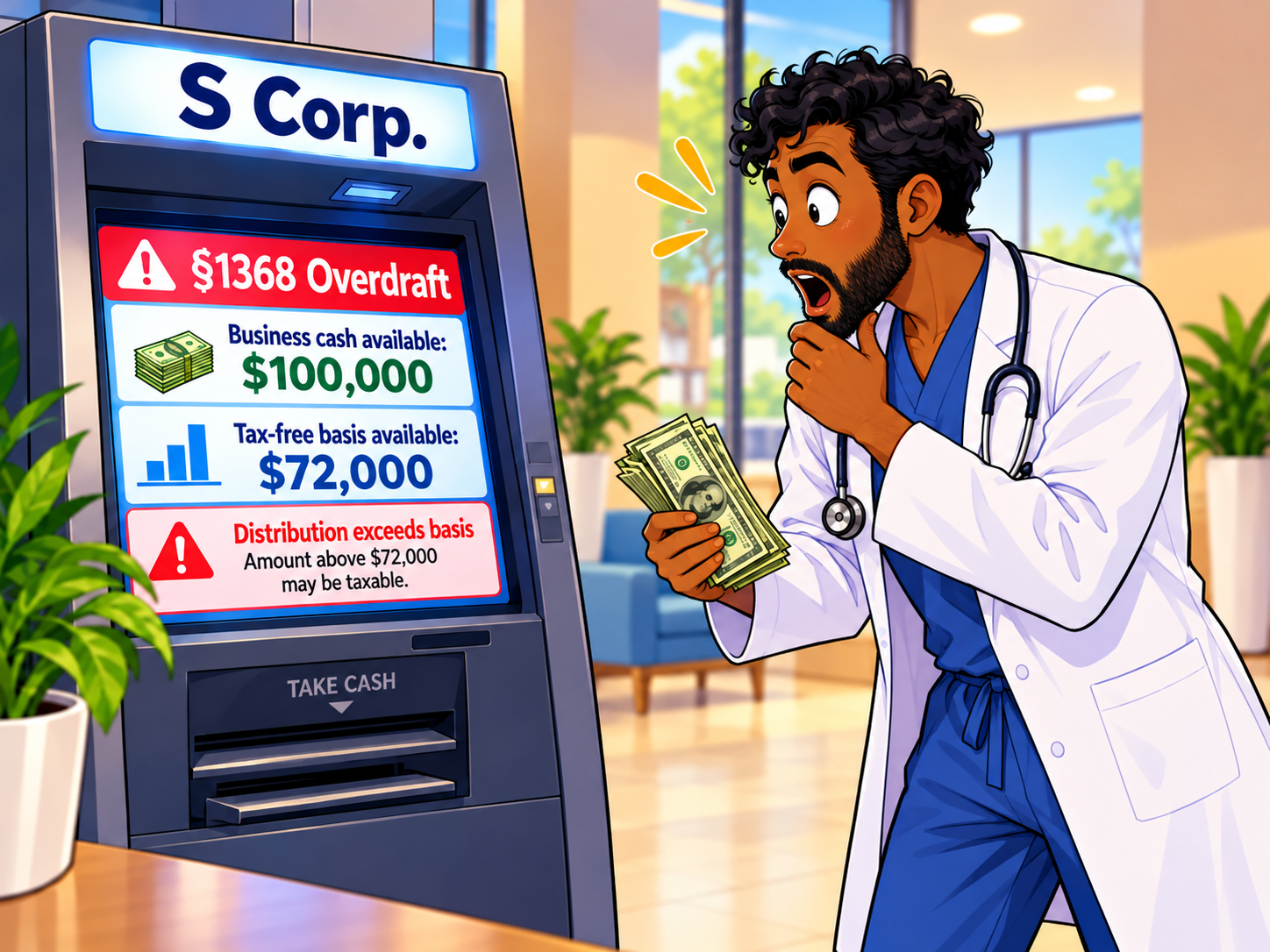
Always check your S Corp’s balance sheet before ordering that new SUV
One of the benefits of an S corporation is that shareholders can generally take distributions without paying additional tax. But there is an important limitation:
S corporation distributions are tax-free only to the extent of the shareholder’s stock basis.
If distributions exceed stock basis, the excess is generally treated as capital gain under IRC §1368. For physicians who routinely distribute most of the cash from their S corporations, this can create an unexpected tax problem—particularly when the corporation has debt, financed equipment, or unpaid year-end retirement-plan obligations.
How §1368 distributions work
This article assumes the S corporation does not have accumulated earnings and profits from a prior C corporation.
Under §1368(b):
Distributions reduce the shareholder’s stock basis.
Distributions are generally tax-free until stock basis reaches zero.
Any additional distribution is treated as gain from the sale or exchange of property—generally capital gain.
Stock basis generally increases from:
capital contributions
S corporation taxable income
tax-exempt income
And decreases from:
distributions
deductible losses and expenses
certain nondeductible expenses
One important point is frequently overlooked: Debt incurred by the S corporation generally does not increase the shareholder’s stock basis. That creates several common traps.
Example 1: The year-end credit card balance
Suppose a physician runs nearly all business expenses through a corporate credit card.
At December 31:
Business checking account: $0
Credit card payable: $5,000
The physician distributed all available cash from the corporation before year-end.
The $5,000 of expenses charged to the credit card generally reduced the S corporation’s taxable income—and therefore reduced the amount of stock basis created by business income.
But the $5,000 credit-card liability does not create additional shareholder stock basis.
The result can be a mismatch:
The shareholder took out the cash, while the corporation still owes the bills associated with the deductions that reduced basis. If distributions are already close to available basis, this can push part of the distribution over basis and create capital gain.
Planning solution
Before making the final distributions for the year, look at outstanding corporate liabilities.
A simple rule of thumb is: Don't empty the corporate bank account on December 31 while leaving unpaid corporate bills behind.
If the business owes $5,000 on its credit card, retaining at least enough cash to satisfy that obligation can help prevent unnecessary excess distributions.
Example 2: Financing equipment and taking bonus depreciation
This issue can become much larger when equipment is financed.
Suppose a physician's practice purchases a $100,000 X-ray machine entirely with financing. The corporation now has:
$100,000 equipment
$100,000 loan payable
The loan itself generally does not increase shareholder stock basis.
Now suppose the practice qualifies for and claims $100,000 of bonus depreciation. That depreciation can dramatically reduce the corporation's taxable income, which means it can also dramatically reduce the shareholder's basis.
Meanwhile, because the equipment was financed rather than purchased with cash, the business may still have plenty of cash available to distribute. That combination is dangerous:
Borrowed money can create cash without creating shareholder basis, while depreciation can reduce taxable income and basis.
If the physician distributes all available cash, the corporation can end up with substantial debt and very little shareholder basis.
Planning solution
When large depreciation deductions are being claimed on financed assets, distributions need to be reviewed before year-end.
Don't assume:
"There's $100,000 in the bank, so I can distribute $100,000."
The better question is:
"How much stock basis will I have after considering income, deductions, and distributions?"
Leaving sufficient cash in the corporation to account for the economic effect of large depreciation deductions can prevent an avoidable §1368 gain.
Example 3: 401(k) and defined-benefit plan contributions
Retirement plans can create an even bigger year-end mismatch.
Physician S corporations frequently make substantial contributions to:
Solo 401(k)s
profit-sharing plans
cash-balance plans
defined-benefit plans
Some employer contributions can be made after December 31 and still be deductible for the prior tax year if the requirements of §404 are satisfied. That creates an unusual situation.
Suppose the corporation will make a $75,000 deductible retirement-plan contribution for 2026, but the contribution will not actually be deposited until 2027. The deduction may reduce 2026 S corporation income—and therefore reduce the shareholder's basis—even though the corporation has not yet spent the $75,000.
If the shareholder distributes that cash before December 31, the corporation can enter the new year with:
little cash,
a large retirement-plan obligation,
and potentially insufficient shareholder basis to support the distributions already taken.
This can be particularly significant with cash-balance and defined-benefit plans, where contributions may be tens of thousands of dollars.
Employee deferrals
Employee 401(k) contributions should be handled differently.
For an S corporation shareholder-employee, employee elective deferrals must be properly elected and recorded through payroll. Once withheld, those amounts should be remitted to the plan promptly.
Ideally, year-end employee deferrals should be dealt with before year-end rather than leaving a large outstanding retirement-plan liability.
Employer contributions
Employer contributions frequently have more flexibility.
It may be perfectly reasonable to fund part of the expected contribution during the year and make the final contribution after the year closes.
But if part of the contribution will be made after December 31, leave enough cash in the corporation to fund it rather than distributing that cash to the shareholder.
For example, if the expected employer contribution is $80,000 and the corporation funds $60,000 before year-end, leaving at least enough corporate cash to cover the remaining $20,000 helps prevent the shareholder from effectively distributing money that is already economically committed elsewhere.
Funding employer contributions can be tricky. The nice thing about them is that they don’t need to be recorded in payroll. However, you want to be careful not to overfund them before the end of the year, while also having enough cash on hand to fund them after the end of the year.
Why this catches physicians
Physician S corporations are particularly susceptible because they often combine:
high cash flow
aggressive distributions
expensive financed equipment
credit-card spending
large retirement-plan contributions
bonus depreciation
A practice can therefore have substantial cash moving through the business while generating surprisingly little year-end stock basis.
The bank balance alone does not tell you how much can safely be distributed.
TaxSmart Takeaway
Before emptying an S corporation's bank account at year-end, look beyond the cash balance.
Ask:
What unpaid credit-card balances exist?
What equipment debt is outstanding?
How much depreciation will be claimed?
What retirement contributions remain to be funded?
What will the shareholder's stock basis actually be after all year-end adjustments?
A little planning before December 31 can prevent an unnecessary capital-gain surprise from a distribution that exceeds basis.
The goal isn't necessarily to keep more money trapped in the corporation. It's to make sure the corporation isn't distributing cash that its tax balance sheet says the shareholder doesn't have sufficient basis to receive tax-free.
If you’re tired of watching basis, distributions, retirement contributions, debt, and year-end cash all at once, TaxSmart MD can help.
As a monthly S corporation client, we monitor these issues throughout the year so distributions stay aligned with basis and year-end tax surprises are less likely.
You take care of patients. We simplify the taxes.