
Is That Drive Deductible? The Rules Every 1099 Physician Should Know
Be sure to read to the end for a special trivia question!
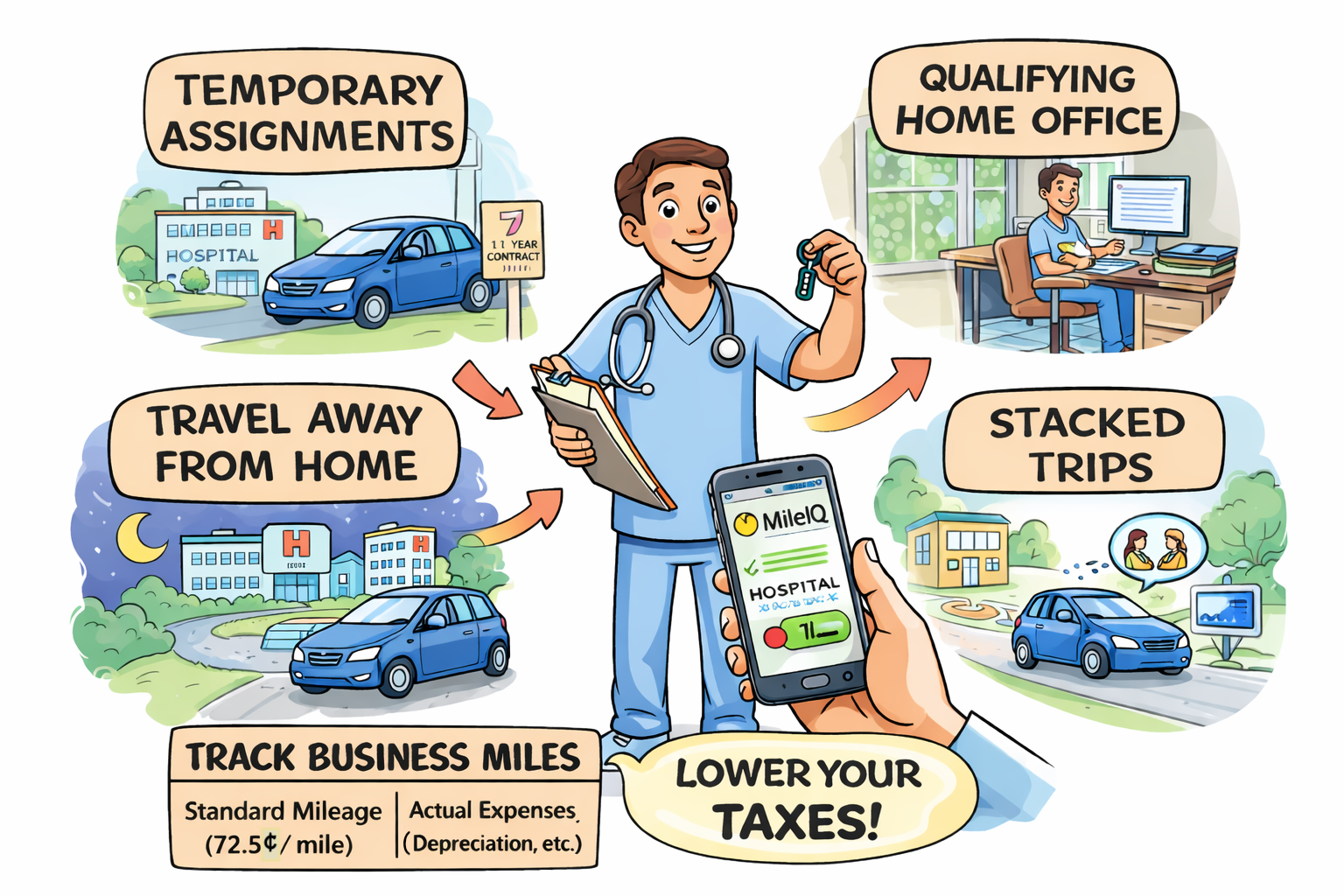
For many self-employed physicians—especially locums, telehealth doctors, and those working at multiple sites—vehicle expenses are one of the most misunderstood deductions in the tax code.
IRS Publication 463 lays out the rules. The principles are straightforward, but the real value comes from understanding how to apply them in real life—and how to plan ahead.
Let’s walk through it.
Personal vs Business Miles
The IRS allows a deduction only for business miles, not personal miles.
Business miles generally include:
Driving between job sites
Driving from your office (including a qualifying home office) to a work location
Driving to from a primary business location meet patients, clients, or vendors
Driving to the bank, pharmacy, or other business errands
Personal miles include:
Commuting
Grocery runs
Driving your kids to school
Weekend trips
If you drive 12,000 miles in a year and 4,000 of those are business miles, then your business-use percentage is 33%. That percentage becomes important if you use the actual expense method (we’ll discuss that later).
The Commuting Rule
One of the most important rules in Pub 463:
Driving from home to your regular place of work is commuting—and commuting is not deductible.
It doesn’t matter if:
The drive is long
You work odd hours
You are on call
You are self-employed
If the location is your regular workplace, the drive there is commuting.
This rule may be surprising. If the only driving you do related to your work is from your residence to the hospital in town (and you don’t have a qualifying home office), you can’t deduct any of your driving expense.
Temporary Job Assignments
Here’s where things get interesting for locums physicians.
Driving to a temporary work location can be deductible if it is outside the metropolitan area in which you live. This is because your “tax home” doesn’t change as the result of a temporary assignment. This language is taken directly from Pub 463:
”If your assignment or job away from your main place of work is temporary, your tax home doesn’t change. You are considered to be away from home for the whole period you are away from your main place of work. You can deduct your travel expenses if they otherwise qualify for deduction. Generally, a temporary assignment in a single location is one that is realistically expected to last (and does in fact last) for 1 year or less.”
A job is generally considered temporary if:
It is realistically expected to last one year or less, and
It does not become indefinite.
If the work is expected to last longer than a year, it’s no longer temporary. If you initially expect the term to be one year or less, but the length of the assignment subsequently changes, then the travel expenses cease to be deductible after the assignment no longer meets the definition of temporary.
This is common in locums arrangements where contracts are short-term or renewable.
If you drive from your tax home to a temporary assignment, those miles may be deductible—especially if you are not commuting to a regular permanent work location.
The Impact of a Qualifying Home Office
A qualifying home office changes the analysis significantly.
If your home office qualifies under IRS rules (regular and exclusive use, principal place of business or administrative center), then:
Your home becomes a business location.
That means:
Driving from home to another work site can become business miles rather than commuting.
This is one of the most powerful but underused planning tools available to self-employed physicians. However, the stipulations for a qualifying home office are strict and should not be brushed aside.
Traveling Away From Home
Driving expenses can also be deductible when you are traveling away from your tax home.
To qualify:
The trip must require sleep or rest, and
It generally involves more than one workday.
Examples:
Driving to another city for a multi-day assignment
Locums work requiring overnight stays
In these cases, mileage to and from the location may be deductible, along with lodging and meals (subject to rules).
A same-day trip typically does not qualify as travel away from home.
How to Track Business Miles
Good documentation is essential.
The IRS expects records showing:
Date
Destination
Business purpose
Miles driven
The easiest way to do this today is through a mileage tracking app.
One of the most commonly used options is MileIQ, which:
Automatically tracks drives
Lets you classify trips
Produces reports at year-end
This is far easier than reconstructing mileage from memory, which rarely holds up well in an audit.
Planning Strategies to Lower Taxes
Knowing the rules is helpful. Planning around them is where the real savings happen.
1. Set Up a Home Office (If It Qualifies)
If you legitimately qualify, a home office can:
Convert many commuting miles into business miles
Increase deductible mileage significantly
This is especially valuable for:
Telehealth physicians
Locums physicians
Physicians managing administrative work from home
But remember: the home office must meet IRS requirements. This is an area where documentation matters.
2. Prefer Temporary Assignments When Possible
Temporary work locations often create:
Deductible mileage
Travel deductions
Lodging and meal deductions
Permanent positions rarely provide these opportunities.
3. “Stack” Your Trips
If you don’t have a home office, try to structure trips so that:
You visit multiple sites or complete errands in one trip
You drive between business locations rather than always from home
Driving between business locations is deductible even when commuting is not.
4. Make Sure Out-of-Town Trips Qualify
If you drive out of town:
Make sure the trip requires sleep or rest
Make sure it spans more than a single workday
Otherwise, what feels like travel may be treated as commuting.
5. Standard Mileage vs Actual Expenses
Each year, you can generally choose between:
Standard mileage method
72.5 cents per mile (2026 rate)
Simple recordkeeping
Often best for fuel-efficient vehicles or moderate mileage
Actual expense method
Gas (or electricity)
Insurance
Repairs
Depreciation
Registration
Lease or loan interest (business portion)
To compare methods, you need:
Total miles driven
Business miles
Business-use percentage
One important detail:
Even if you use the standard mileage method, you may still deduct:
Parking fees
Tolls
Business portion of auto loan interest
Business portion of property taxes on the vehicle
TaxSmart Takeaway
Vehicle deductions are not about finding loopholes—they are about understanding definitions.
The biggest drivers of savings usually come from:
A qualifying home office
Temporary assignments
Traveling away from your tax home
Proper mileage tracking
Choosing the right deduction method
For many self-employed physicians, these factors can mean thousands of dollars in tax savings each year—not because the rules are aggressive, but because they are applied correctly.
Special Trivia Question!
IRS Revenue Ruling 1999-7 established that traveling from one’s home to a temporary work location, outside of a taxpayer’s metropolitan area, is a deductible business expense.
How does this ruling define “metropolitan area?”
A. 25 miles from the taxpayer’s residence
B. 50 miles from the taxpayer’s residence
C. Anywhere outside the taxpayer’s Metropolitan Statistical Area
D. Any location that realistically requires more than an hour of driving
E. No definition is provided
Click here for the answer!