
Read to the end for a special trivia question!
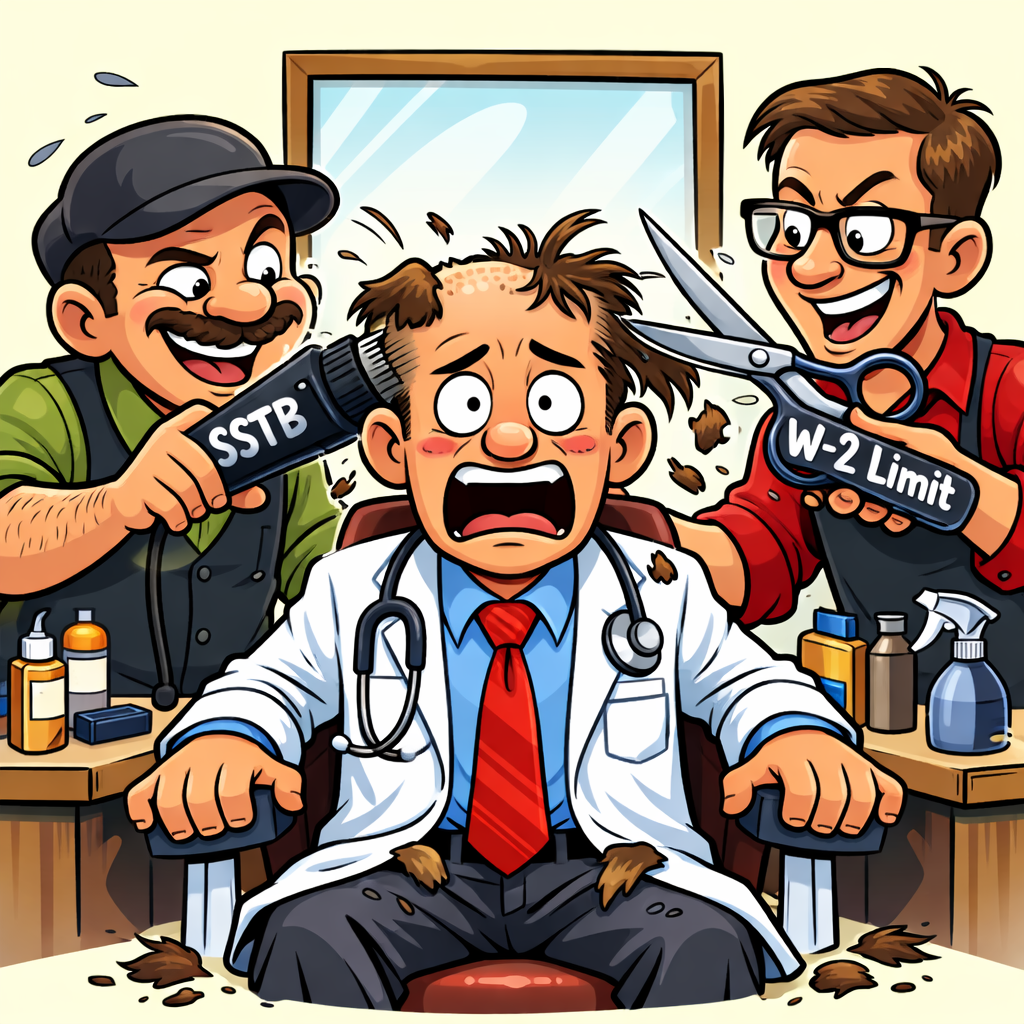
When it comes to tax haircuts, two is worth less than the price of none!
If you’re a physician, the Qualified Business Income (QBI) deduction can feel like a moving target.
Below a certain income level, the deduction is straightforward and valuable. Above it, the deduction disappears entirely.
But in between, things get more complicated.
There is a middle zone where the deduction doesn’t just phase out—it can get reduced from multiple angles at once. Understanding how that works is important, especially when evaluating whether an S corporation election makes sense.
Part I: Quick Review of the QBI Deduction
At a high level, the QBI deduction allows you to deduct:
Up to 20% of your qualified business income.
There is also an overall limitation:
The deduction cannot exceed 20% of taxable income (excluding net capital gains).
Basic framework
If your taxable income is below a certain threshold:
You generally receive the full 20% deduction.
If your income exceeds that threshold:
Additional limitations apply.
For 2026:
Married Filing Jointly: $403,500 to $553,500
Single/MFS: $201,750 to $276,750
For physicians (a Specified Service Trade or Business, or SSTB):
The deduction phases out over this range.
At the top, the deduction is completely eliminated.
What counts as QBI?
Sole Proprietor
QBI is generally net Schedule C income, reduced by:
The deductible portion of self-employment tax
Self-employed health insurance
Pre-tax retirement contributions
S Corporation
QBI is net income after subtracting:
Business expenses
Owner W-2 compensation
Paying yourself W-2 wages reduces QBI, which is often viewed as a disadvantage of the S corporation election.
The SSTB phase-out
Once taxable income enters the phase-out range:
Only a percentage of QBI counts toward the deduction.
That percentage declines linearly.
At the top of the range, none of the income qualifies.
The Wage and Property Limitation
There is another limitation that begins to apply in this same income range.
The QBI deduction cannot exceed the greater of:
50% of W-2 wages, or
25% of W-2 wages plus 2.5% of UBIA (unadjusted basis of qualified property).
For most physicians, this limitation is driven by W-2 wages.
The Key Interaction
For SSTBs in the phase-out range, two things happen at the same time:
Only a portion of QBI (and wages) counts.
The wage limitation begins to apply.
In certain situations—especially when there are no W-2 wages—these effects can stack in a way that significantly reduces the deduction.
Part II: Example — Sole Proprietor
Assume:
Married filing jointly
Taxable income = $478,500 (midpoint of 2026 phase-out range)
QBI = $300,000
No W-2 wages
Step 1: Initial QBI deduction
20% × $300,000 = $60,000
Step 2: SSTB phase-out
At the midpoint of the phase-out range, 50% of QBI is considered.
So:
Adjusted QBI = $150,000
Adjusted deduction = $30,000
Step 3: Wage limitation
Because there are no W-2 wages, the wage limitation is zero.
As the limitation phases in, the deduction is further reduced
Final deduction: $15,000
Analysis
At the midpoint of the phase-out range, the deduction is effectively reduced twice. Once by the SSTB rules, and again by the wage limitation
This creates a significant reduction for sole proprietors without wages or qualified property.
Part III: Same Example — S Corporation
Now assume the same scenario, but with:
$200,000 of W-2 wages
$100,000 of remaining QBI
Step 1: Initial QBI deduction
20% × $100,000 = $20,000
Step 2: SSTB phase-out
At the midpoint:
Deduction becomes $10,000
Step 3: Wage limitation
Compare:
Deduction: $10,000
Wage limit: 50% × $200,000 = $100,000
Because the wage limit is higher:
No additional reduction applies
Final deduction: $10,000
Putting It Together
Before any phase-out:
Sole proprietor advantage: $40,000 ($60,000 vs $20,000)
At the midpoint of the phase-out:
Advantage shrinks to $5,000 ($15,000 vs. $10,000)
Why This Matters
The QBI deduction is often cited as a reason to avoid an S corporation election.
However, once taxable income enters the phase-out range:
Sole proprietors may lose a significant portion of the deduction due to the interaction of these rules.
S corporations, while starting with lower QBI, may avoid additional reductions because of W-2 wages.
As a result:
The difference in QBI benefit between the two structures becomes much smaller.
Important Caveats
The outcome is highly sensitive to:
W-2 compensation
Total income
Filing status
W-2 wages must be reasonable based on the services performed
QBI is only one component of entity selection. Other factors include:
Payroll tax savings
Retirement planning opportunities
State taxes and PTET elections
Administrative complexity
TaxSmart Takeaway
Once an SSTB enters the phase-out range, the QBI deduction becomes less predictable and less valuable.
Sole proprietors without W-2 wages are more exposed to reductions in this range.
S corporations reduce QBI upfront, but may limit the impact of the wage-based restriction.
The net effect is that the QBI “penalty” of an S corporation is often smaller than expected.
As income increases within the phase-out range, an S corporation election becomes more competitive. In some cases, it may even produce a better overall result—but the math needs to be run carefully.
Special Trivia Question!
Physicians and many other service-based professionals are subject to the taxable income phase out of the QBI deduction, because the activity falls under the umbrella of an SSTB. However, if a trade or business is determined to NOT be an SSTB, the deduction is limited by wages. Which of these possible side hustles might NOT be an SSTB? Choose the two that apply:
A. Selling Medical Supplements
B. Rental Real Estate
C. Paid Endorsements
D. Consulting
E. Telemedicine
Click here for the answer!