
Section 105 Medical Reimbursement Plans: A Powerful but Narrow Strategy for Physician Families
Be sure to read to the end for a special trivia question!
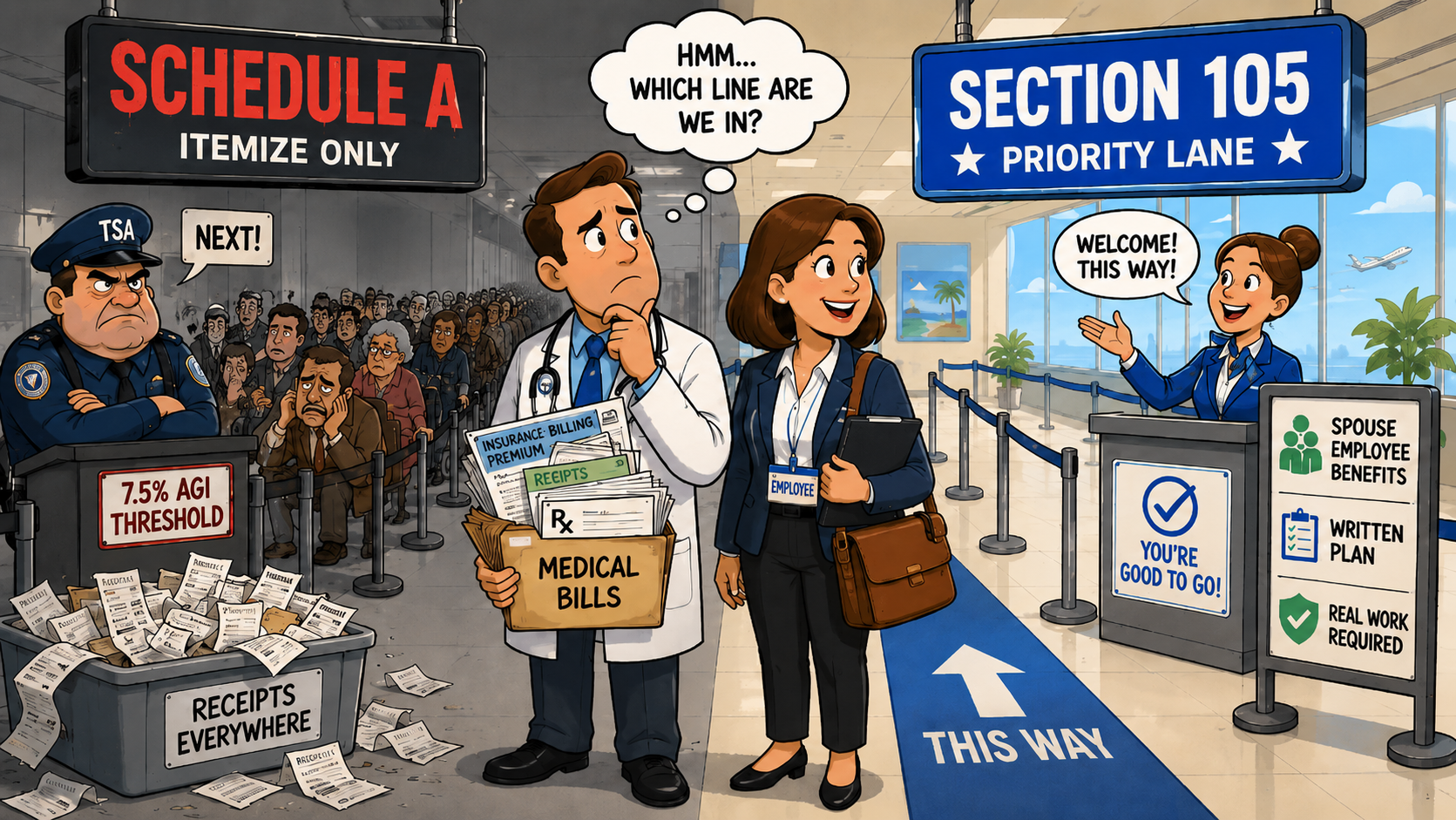
Most solopreneur physicians are familiar with the self-employed health insurance deduction. If you are self-employed and pay for your own health insurance, you may be able to deduct the premiums above the line instead of treating them as an itemized medical expense. That is valuable, especially for physicians buying coverage on the individual market, but it has limits. It generally does not allow you to deduct all out-of-pocket medical expenses, and it does not turn every family healthcare cost into a business deduction.
A Section 105 medical reimbursement plan is different. In the right fact pattern, it can allow a business to reimburse an employee for health insurance premiums and out-of-pocket medical expenses, deduct those reimbursements as a business expense, and keep the reimbursements tax-free to the employee.
This can be powerful, but it is not a magic wand. It does not work well for every entity type, and it is not appropriate unless the spouse is actually performing legitimate work for the business. It also needs to be documented and administered like a real employee benefit plan, not treated as an informal arrangement where the business simply pays whatever medical bills happen to show up.
1. Who Is Eligible?
The cleanest use case is a sole proprietor who hires a spouse to perform legitimate services for the business. This could include scheduling, bookkeeping, patient communication, billing support, vendor coordination, website updates, marketing, office administration, or other real work that the business would otherwise need to perform or outsource. The spouse needs to be a real employee, not just a name on paper. There should be a job description, actual duties, reasonable compensation, and documentation that the spouse is actually doing the work.
This is most commonly discussed for Schedule C businesses because a sole proprietor cannot be their own employee. The owner cannot simply set up a Section 105 plan for themselves and treat their own medical costs as employee reimbursements. But the spouse can be an employee of the sole proprietorship. If the spouse is the employee covered by the plan, and the plan reimburses the employee for eligible family medical expenses, the benefit may indirectly cover the owner as part of the spouse’s family.
Why does the business need to be a sole proprietorship? With an S Corp, close family members, including spouses are treated as highly compensated individuals because of attribution of ownership. The medical reimbursement plan can’t discriminate in favor of highly compensated individuals, so the strategy fails.
2. What It Allows the Business to Deduct
A properly designed Section 105 medical reimbursement plan can allow the business to deduct reimbursements for medical expenses paid to the spouse-employee. Depending on the plan design, this can include health insurance premiums, deductibles, copays, coinsurance, prescriptions, dental expenses, vision expenses, and other qualifying medical expenses. The key is that the expense needs to qualify as a medical expense and needs to be reimbursed under the written plan.
This can go beyond the self-employed health insurance deduction. The SEHI deduction is valuable, but it is mainly about health insurance premiums. A Section 105 plan, if properly structured, may allow the business to deduct not only the family health insurance premiums, but also unreimbursed out-of-pocket medical expenses covered by the plan. What’s more, these deductible expenses will lower the physician owner’s self-employment tax.
That can be much better than trying to deduct medical expenses on Schedule A. For a high-income physician, Schedule A medical deductions are often close to useless because expenses are only deductible to the extent they exceed 7.5% of adjusted gross income, and only if the taxpayer itemizes. By contrast, a properly structured Section 105 reimbursement is a business deduction to the employer and tax-free to the employee.
There is one significant tradeoff: a Section 105 plan that provides first-dollar medical coverage will disallow HSA eligibility. In plain English, you generally cannot have an HSA-compatible high-deductible health plan while also having a broad Section 105 plan that reimburses first-dollar medical expenses.
3. Why Nondiscrimination Rules Can Make This Dicey
The Section 105 spouse reimbursement strategy is much cleaner when the spouse is the only employee. Once the business hires other employees, the analysis becomes more complicated. Medical reimbursement plans are subject to nondiscrimination rules, and a plan that disproportionately benefits highly compensated individuals can create tax problems.
This is why the strategy can be dicey for a growing medical practice. If the physician has nurses, medical assistants, front desk staff, billers, or other common-law employees, the business may not be able to provide a generous reimbursement plan only to the spouse and exclude everyone else. The plan may need to be offered more broadly, which will drive up the costs. A plan that sounds great when it covers only one spouse-employee may become impractical if it must also cover several unrelated employees.
For this reason, Section 105 spouse reimbursement planning tends to work best in very small businesses with no other employees. If the physician is operating a lean solo practice, concierge practice, consulting business, expert witness business, or administrative side business where the spouse is genuinely the only employee, the strategy may be worth considering. If the physician is running a full clinical practice with a staff, payroll, and multiple employees, the nondiscrimination issues can make the strategy far less attractive.
4. Steps to Set This Up Properly
The first step is to make sure the spouse is doing legitimate work. The business should have a real need for the spouse’s services, and the work should be documented. It is not enough to say the spouse “helps with the business” if there are no defined duties, no records, and no reasonable way to value the work performed. If the IRS asks why the spouse was hired, the answer should sound like a normal business decision, not a tax strategy. Practically, this is a significant restriction.
The second step is to define the Section 105 plan as part of the spouse’s compensation package. This is important because the spouse’s total compensation needs to be reasonable for the work performed. If the spouse’s work is worth $20,000 per year and the business provides $50,000 of medical reimbursements, that is a problem. The plan should fit within a reasonable total compensation arrangement, taking into account salary, reimbursements, and other benefits.
The third step is to put a cap on the reimbursement benefit. An uncapped plan can create both tax and business problems. A written plan might say that the spouse-employee is eligible for reimbursement of family health insurance premiums and qualifying medical expenses up to a stated annual amount. This helps show that the benefit is part of a defined compensation arrangement rather than an open-ended promise to pay all family medical costs forever.
Finally, the business needs a written plan document and proper administration. The plan should describe who is eligible, what expenses are reimbursable, the reimbursement limit, substantiation requirements, and the process for submitting claims. The employee should submit proof of expenses, and the business should reimburse only eligible expenses under the plan.
5. Example: Small Concierge Practice With No Other Employees
Assume a physician operates a small concierge practice as a sole proprietor. The practice has no other employees. The physician’s spouse handles scheduling, patient communication, bookkeeping, vendor coordination, website updates, and general administrative support. Based on the work performed and the local market, fair market compensation for the spouse’s role is approximately $45,000 per year.
Instead of paying the spouse the full $45,000 in cash wages, the business establishes a written Section 105 medical reimbursement plan as part of the spouse’s compensation package. The plan reimburses family health insurance premiums of $30,000 per year and anticipated out-of-pocket medical expenses of up to $6,000 per year. The spouse is also paid $9,000 of cash wages. The total compensation package is $45,000: $36,000 of medical reimbursement benefits plus $9,000 of salary.
This is the type of fact pattern where the strategy can make sense. The spouse is doing real work. The business has no other employees. The reimbursement benefit is capped. The total compensation is tied to the fair market value of the services performed. The plan is documented in writing and administered through substantiated reimbursements. The family also understands that because the plan provides broad medical reimbursement coverage, HSA contributions may not be allowed.
TaxSmart Takeaway
A Section 105 spouse medical reimbursement plan can be a powerful strategy for a sole proprietor who hires a spouse to perform legitimate work, especially when the business has no other employees. However, this is a fairly narrow set of facts, and a careful analysis should consider the significance of the spouse’s role in the business, appropriate entity structure, and the possibility that the medical practice will expand and require hiring outside employees. In the right situation, the tax benefits can be meaningful, resulting in thousands of dollars of income tax and self-employment tax savings.
Special Trivia Question!
A Section 105 Medical Reimbursement Plan can cover other types of insurance, in addition to medical insurance. Which insurance can this plan NOT cover?
A. Disability Insurance
B. Vision Insurance
C. Dental Insurance
D. Long-term Care Insurance
Click here for the answer!