
Don't Let Your S Corp Take the Wheel: Why Business-Owned Cars Can Drive Up Your Taxes
Be sure to read to the end for a Special Trivia Question!
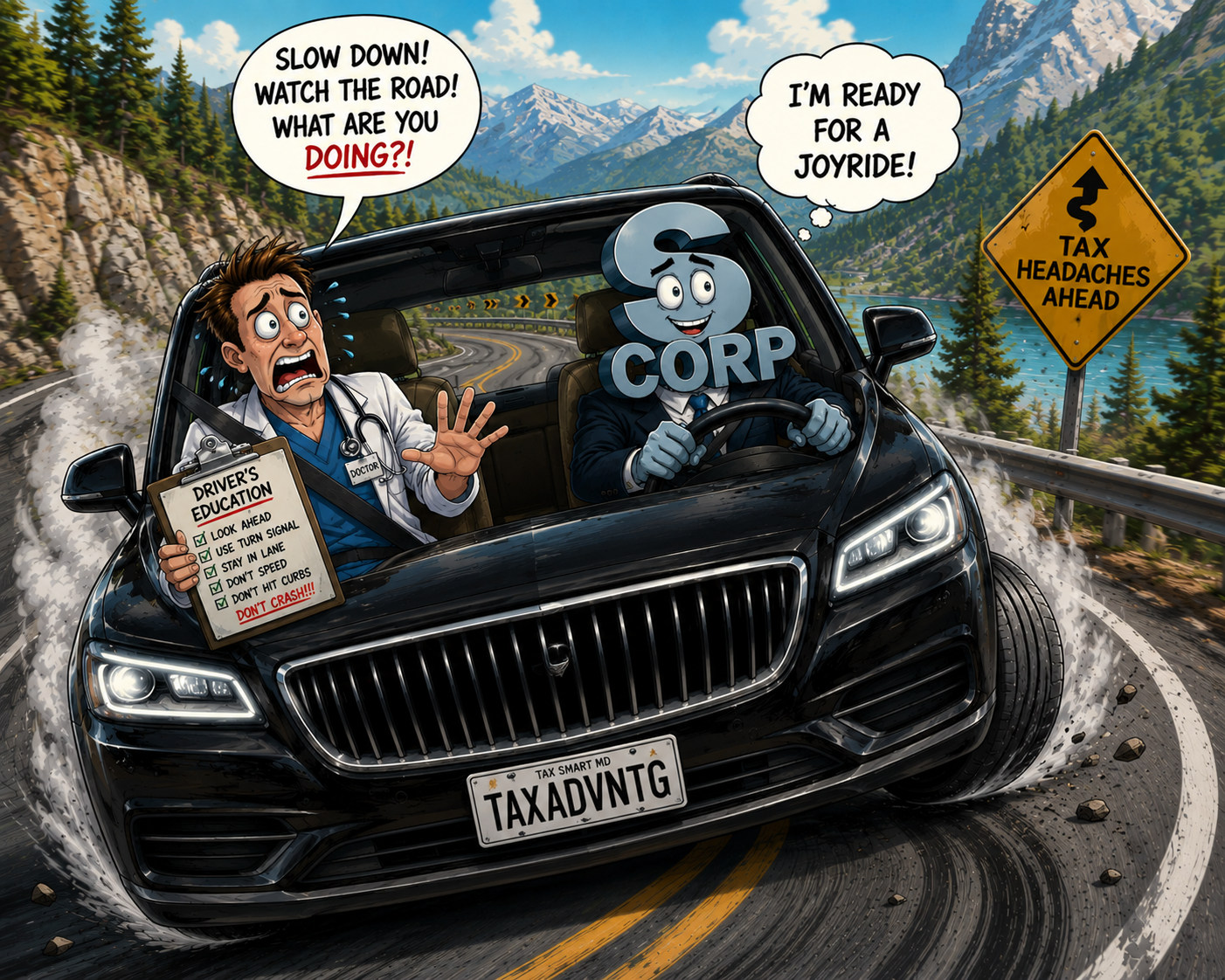
S Corps are good at reducing self-employment taxes. Obeying stop signs is a different story.
When physicians and other business owners elect S corporation status, one of the first questions they ask is:
"Should I put my car in the business?"
It seems logical. If the business uses the vehicle, shouldn't the business own it?
Surprisingly, the answer is often no.
While there are situations where S corporation ownership makes sense, personally owning your vehicle and using an accountable plan is frequently the cleaner, more tax-efficient option.
Two Ways to Deduct Vehicle Expenses
There are two common approaches.
Option 1: The S Corporation Owns the Vehicle
The corporation purchases (or leases) the vehicle and deducts the business-use portion of expenses, including:
Gas
Repairs and maintenance
Insurance
Registration
Depreciation
If the shareholder uses the vehicle personally, however, that personal use generally becomes a taxable fringe benefit.
Option 2: The Shareholder Owns the Vehicle
Instead, the shareholder keeps the vehicle in their own name and submits business mileage or vehicle expenses through an accountable plan.
The corporation reimburses either:
The IRS standard mileage rate, or
Actual expenses based on business use.
Properly documented reimbursements are generally deductible by the corporation and tax-free to the shareholder.
When S Corp Ownership Makes Sense
Business ownership isn't always a bad idea.
Section 179 or Bonus Depreciation
If the vehicle qualifies for Section 179 or bonus depreciation, having the corporation own the vehicle may accelerate deductions in the early years.
Little or No Personal Use
If the vehicle is used almost exclusively for business, the taxable fringe benefit may be minimal.
Liability Considerations
Certain commercial vehicles or businesses with elevated liability concerns may benefit from having the vehicle titled in the business. This is often more of a legal or insurance decision than a tax one.
The Hidden Costs of S Corp Ownership
Personal Use Creates Taxable Wages
Most S corporations use the Annual Lease Value method to determine the value of an owner's personal use of a company vehicle, although the IRS also permits other methods—such as the cents-per-mile method—for vehicles meeting specific eligibility requirements.
The value of personal use is generally:
Added to your Form W-2
Subject to federal income tax
Subject to Social Security and Medicare taxes
Many owners are surprised to learn that commuting, weekend errands, and family trips in a company-owned vehicle can increase both income tax and payroll tax.
Getting the Car Back Isn't Free
Eventually, many owners want to transfer the vehicle into their personal name.
Unfortunately, this is not simply a title transfer.
When an S corporation distributes a vehicle to its shareholder, it is generally treated as though the corporation sold the vehicle at its fair market value.
If the vehicle has been heavily depreciated, the corporation may recognize taxable gain—even if the vehicle has declined in value since it was purchased.
Why I Usually Prefer an Accountable Plan
For many S corporation owners, the accountable plan is simply the cleaner solution.
Flexibility
You can choose whichever reimbursement method provides the best tax result:
Standard mileage reimbursement
Actual expense reimbursement
You aren't locked into corporate ownership.
No Taxable Fringe Benefit
Because the corporation is simply reimbursing business expenses, the reimbursement generally:
Isn't added to your W-2
Isn't subject to Social Security or Medicare tax
Doesn't require annual fringe benefit calculations
That means less payroll complexity and often lower overall taxes.
Rules That Apply Either Way:
Regardless of who owns the vehicle, some rules never change.
Good Records Are Required
Business vehicle expenses are subject to the heightened substantiation requirements of IRC §274(d)(3) because passenger automobiles are considered listed property.
Maintain records showing:
Date
Destination
Business purpose
Business mileage
Without adequate substantiation, the IRS can deny the deduction entirely.
Depreciation May Be Recaptured
If depreciation has been claimed using the actual-expense method, selling the vehicle may trigger depreciation recapture.
This can occur whether the vehicle is owned personally or by the S corporation.
TaxSmart Takeaway
For many physicians and other S corporation owners, personally owning the vehicle and using an accountable plan is the better long-term strategy.
While business ownership can make sense in limited situations—particularly when Section 179, bonus depreciation, or liability concerns are involved—it also introduces taxable fringe benefits, payroll taxes, and potential tax consequences when the vehicle is eventually transferred or sold.
Before putting your next vehicle in your S corporation, take a step back and evaluate both the short-term deduction and the long-term tax cost. Sometimes the biggest deduction today creates the biggest headache tomorrow.
Special Trivia Question!
The standard mileage rate for automobiles is 72.5 cents in 2026. How much has this increased in the last 10 years?
A. 31%
B. 34%
C. 39%
D. 44%
Click here for the answer!