
The State Tax Deduction That Most Often Gets Missed
Be sure to read until the end for a special trivia question!

Most taxpayers know that interest from U.S. Treasury securities is taxable on the federal return. What many do not realize is that this income is generally exempt from state and local income tax.
The exemption can apply to:
Interest received directly from Treasury bills, notes, and bonds.
The portion of a mutual fund or money market fund dividend attributable to qualifying U.S. government obligations.
That second category is where the deduction most often gets missed.
Why this deduction is easy to overlook
The state-exempt amount usually does not appear as a separate number on Form 1099-DIV.
Instead, the brokerage reports the fund’s entire distribution as ordinary dividends in Box 1a. The taxpayer or tax preparer must then determine what percentage of that dividend came from qualifying government obligations.
In other words, the 1099 might tell you that a fund paid $1,584.20 of ordinary dividends—but it may not tell you how much is exempt from state tax.
That information may appear in the supplemental pages accompanying the 1099. In other cases, you must find an annual tax-information document on the mutual fund company’s website.
Example: Fidelity Treasury Only Money Market Fund
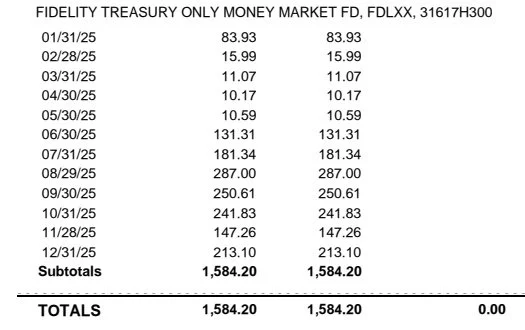
The statement above reports distributions from the Fidelity Treasury Only Money Market Fund, FDLXX.
The monthly amounts total $1,584.20, which is reported as ordinary dividend income.
For 2025, Fidelity reports that 98.67% of the income from its Treasury Only Money Market Fund was eligible income from U.S. government securities.
The calculation is:
$1,584.20 × 98.67% = $1,563.13
Therefore:
Federal taxable dividend income: $1,584
Potential state subtraction: $1,563
Remaining dividend taxable by the state: $21
The federal return still reports the full $1,584.20. The $1,563 exclusion is generally entered as a subtraction or adjustment on the applicable state return.
Do not simply assume that 100% of the distribution is exempt because the fund’s name contains the word “Treasury.” The fund company’s annual percentage should be used.
Where to find the percentage
Start with the supplemental information attached to the consolidated 1099. Look for headings such as:
U.S. government securities income
U.S. government obligations
State tax-exempt income
Supplemental tax information
When the percentage is not included with the 1099, check the fund company’s tax-information page.
2025 mutual-fund information
Fidelity specifically instructs investors to multiply the ordinary dividends received from each applicable fund by the percentage shown in its annual government-securities table. Vanguard and Schwab publish similar annual tax resources for their funds.
Important state limitations
The precise treatment depends on the taxpayer’s state and the type of obligation held by the fund.
Not every investment described as a “government” security necessarily qualifies. For example, income from repurchase agreements or certain government-sponsored enterprises may not receive the same treatment as direct Treasury obligations.
Some states also impose minimum-asset tests before permitting a mutual fund to pass the exemption through to its shareholders. Fidelity notes that California, Connecticut, and New York apply minimum-investment requirements and identifies funds that did not meet them with an asterisk in its annual table.
TaxSmart Takeaway
When a taxpayer owns Treasury, government bond, or government money market funds, do not stop at the numbersprinted in Boxes 1a of the 1099-DIV.
Review the supplemental information, identify each fund, find the applicable government-obligation percentage, and calculate the state subtraction.
It is a small additional step—but for taxpayers holding substantial cash or fixed-income investments, it can prevent thousands of dollars of federally taxable income from also being taxed unnecessarily by the state.
Special Trivia Question!
Which of these is taxable at the state level, but usually not at the federal level?
A. Interest paid by the IRS for a delayed refund
B. Interest paid by a state for a delayed refund
C. Series I and Series EE Bonds
D. Municipal Bonds
Click here for the answer!