
Be sure to check out the Special Trivia Question at the end!

For years, when clients asked whether they should deduct a business vehicle using the standard mileage rate or actual expenses, I relied largely on rules of thumb.
Expensive vehicle? Actual expenses probably deserve a closer look.
Lots of business miles? Standard mileage often starts looking better.
Cheap, fuel-efficient car? Mileage may be hard to beat.
Those rules are useful, but I wanted something more quantitative. So I built the new TaxSmart MD Vehicle Expense Calculator.
After testing a variety of scenarios, I found that three variables matter much more than almost everything else:
Vehicle value
Annual mileage
How long you keep the vehicle
The Base Scenario
For comparison, I started with:
$50,000 vehicle
5,000 business miles and 5,000 personal miles per year
50% business use
6 years in service
$1,333 annual fuel cost
$2,000 annual insurance
$2,000 annual maintenance and repairs
$5,000 eventual depreciation recapture
Then I changed one variable at a time.
1. Vehicle Value Matters More Than I Expected
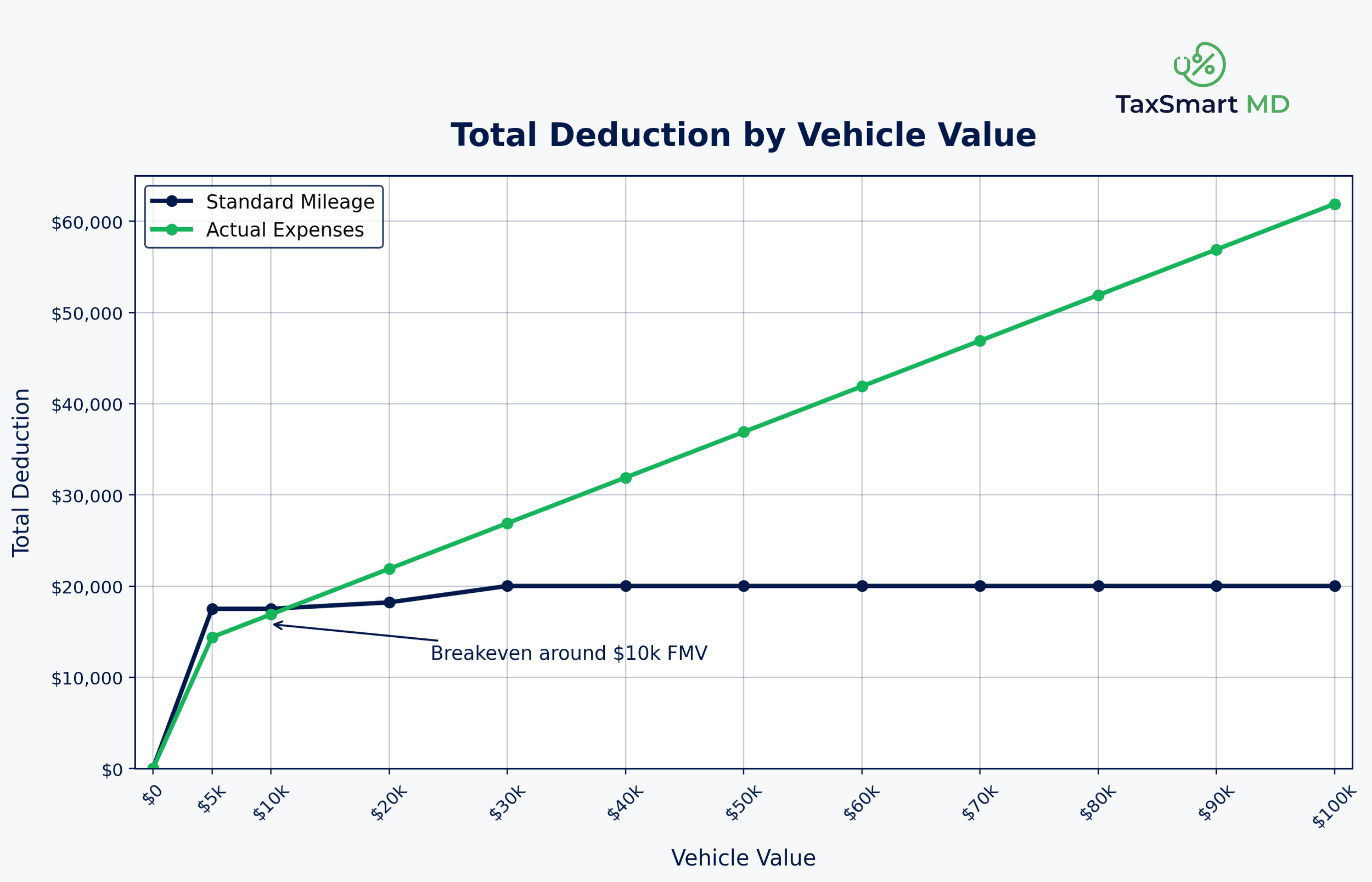
Figure A. Total deductible vehicle business expenses as a function of Fair Market Value (FMV) when placed in service.
This was the most surprising result.
In the base scenario, actual expenses begin to outperform standard mileage at a vehicle value of only around $10,000. As vehicle value increases, the gap widens quickly.
The reason is depreciation.
A $50,000 vehicle used 50% for business has far more business basis available to depreciate than a $15,000 vehicle. Meanwhile, the standard mileage rate is the same regardless of whether you drive a cheap used car or an expensive SUV.
That suggests more taxpayers should consider tracking actual expenses, especially when:
The vehicle is relatively expensive
Business mileage is low to moderate
The vehicle will not be kept far beyond its depreciation period
Given current vehicle prices, this may apply to more people than you might expect.
2. Higher Annual Mileage Favors Standard Mileage
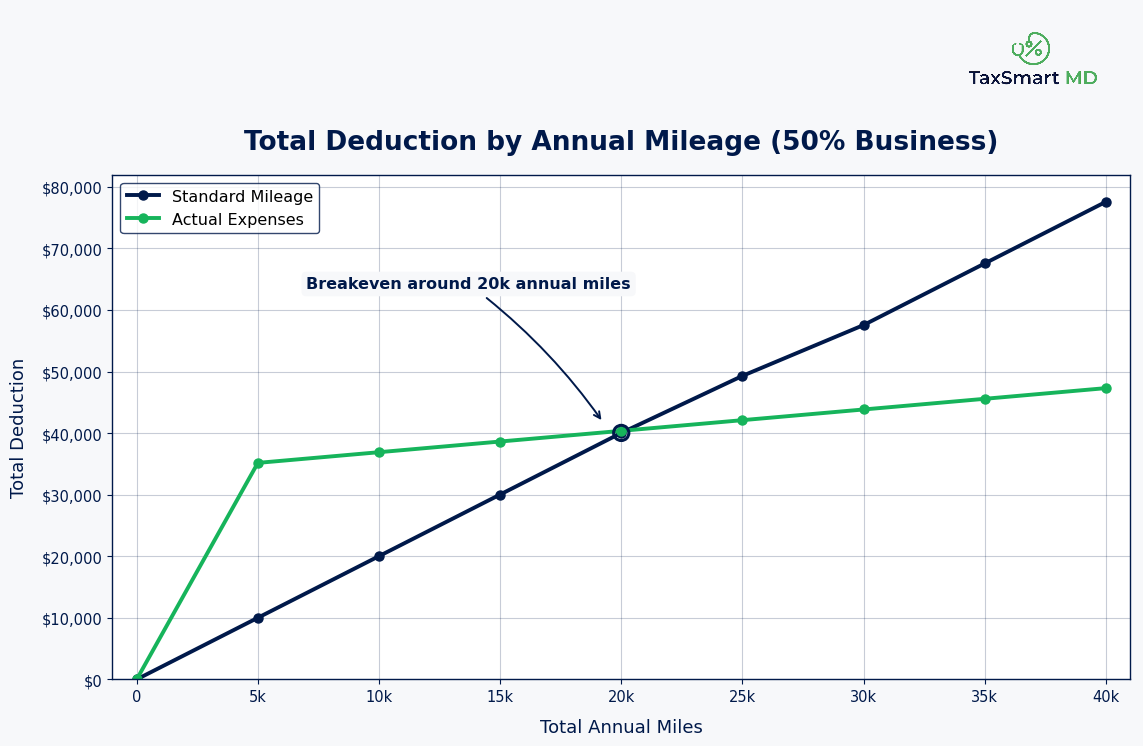
Figure B. Total deductible vehicle business expenses as a function of Total Annual Miles (50% business).
Annual mileage pushes the result in the opposite direction.
In this scenario, the breakeven point is around 20,000 total annual miles, or roughly 10,000 business miles at 50% business use.
The standard mileage deduction rises almost linearly with business miles. Drive more business miles, and the deduction increases accordingly.
Actual expenses do not behave the same way.
Some of the largest expenses are relatively fixed. Most importantly, depreciation is driven by the vehicle's basis and business-use percentage, not simply by the number of miles driven.
Insurance also does not double because mileage doubles.
Fuel and maintenance increase with more driving, but usually not fast enough to keep pace with the standard mileage deduction.
So, as a general rule:
The more business miles you drive, the more attractive standard mileage becomes.
3. Keeping the Vehicle Longer Helps Mileage Catch Up
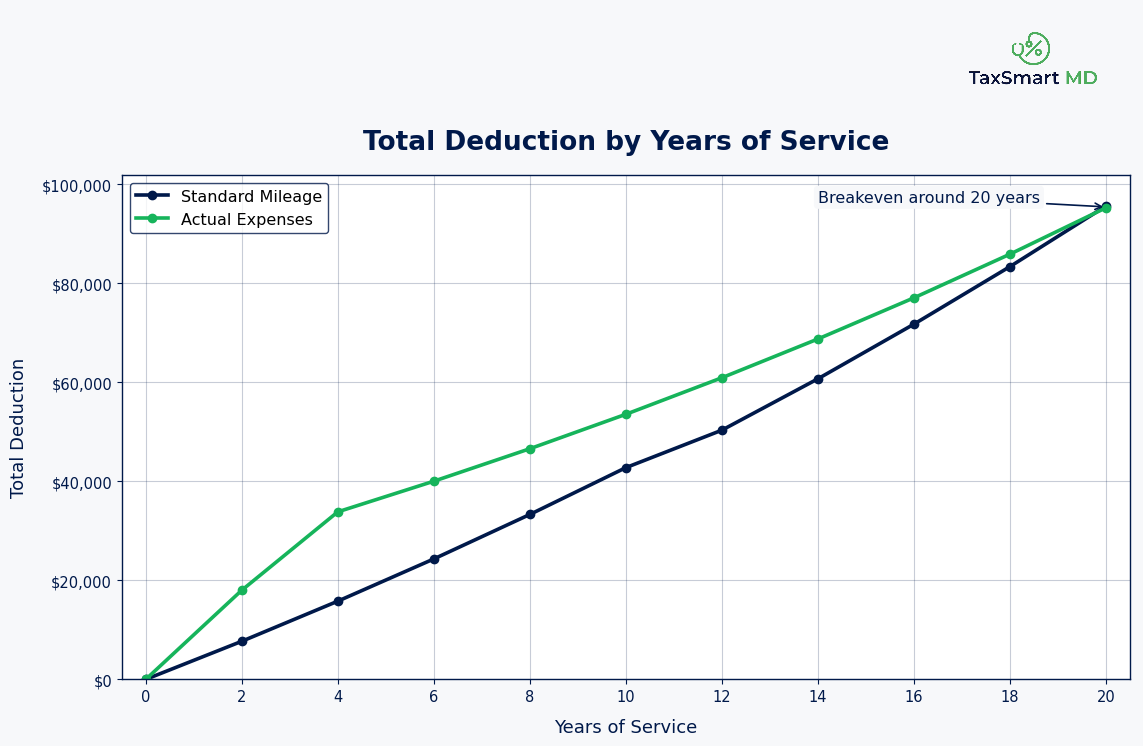
Figure C. Total deductible vehicle business expenses as a function of Years of Service
Early in the vehicle's life, actual expenses have a large advantage in the base scenario.
But that advantage narrows over time.
Why? Depreciation eventually runs out.
Vehicles are generally 5-year property for federal depreciation purposes. Under the half-year convention, the deductions usually stretch across six tax years, but eventually there is no depreciation left to claim.
Fuel, insurance, maintenance, repairs, and registration continue, but the largest deduction may be gone.
Standard mileage works differently. As long as you remain eligible to use it, qualifying business miles continue to generate a deduction even after the vehicle is 8, 10, or 15 years old.
In the base scenario, the two methods are nearly equal by around 20 years.
So:
The longer you keep the vehicle, the more standard mileage tends to catch up.
What About Gas, Insurance, and Repairs?
These expenses matter, but less than I expected.
The calculator separately includes:
Gasoline
Electricity
Insurance
Maintenance and repairs
Registration
All of these can vary substantially between taxpayers.
But in many scenarios, they are dwarfed by depreciation.
In the base case, even if you reduce several of these operating costs dramatically, actual expenses can still come out ahead because the vehicle has so much depreciable basis.
That was probably my biggest takeaway from building the calculator:
Vehicle tax planning is often more about depreciation versus mileage than it is about gas prices or repair bills.
My New Rules of Thumb
After running the numbers, I would summarize it this way:
Expensive vehicle + low or moderate business mileage:
Actual expenses deserve serious consideration.
Inexpensive vehicle + lots of business mileage:
Standard mileage is often very attractive.
Mixed fact pattern:
Run the numbers.
And if the two methods produce similar results, I would strongly consider standard mileage simply because it is easier to track.
Actual expenses require records for fuel, insurance, repairs, maintenance, registration, and other costs.
Standard mileage still requires a good mileage log, but the recordkeeping is much simpler.
If one method clearly produces a much larger deduction, the extra work may be worthwhile.
If the difference is small, simplicity has value.
TaxSmart Takeaway
After building the calculator, I now look at three questions first:
How expensive is the vehicle?
Higher value generally favors actual expenses because of depreciation.
How many business miles will you drive?
Higher mileage increasingly favors standard mileage.
How long will you keep the vehicle?
The longer you keep it, the more mileage can catch up after depreciation under the actual expense method is exhausted.
Fuel, insurance, repairs, and other operating costs still matter, but they are often secondary.
If your fact pattern falls somewhere in the middle, don't guess.
Run the numbers with the TaxSmart MD Vehicle Expense Calculator.
Special Trivia Question!
As of this writing (October 2026), the standard mileage rate for automobiles is 76 cents per mile. What is the standard mileage rate for motorcycles?
A. 28 cents per mile
B. 45 cents per mile
C. 51 cents per mile
D. 54 cents per mile
E. None of the above
Click here for the answer!