

1099s Made Simple: Who Gets One, Who Doesn’t, and How to Avoid IRS Headaches
Every January, business owners across the country are reminded that with great power (1099 income) comes great responsibility (issuing 1099s to others).
If you pay contractors for services, the IRS expects you to report those payments — and they’ve built several traps that catch people who don’t understand the rules.

Why Your Marginal Tax Rate Isn’t 24%
Most people quote their marginal tax rate from the federal tax brackets. But your true marginal rate is the sum of several layers of taxes—federal, state, payroll, and sometimes even city. And your marginal rate can differ depending on whether the income is earned (salary or self-employment), passive (investments), or from a business.

Should Solopreneurs Add a Cash Balance Plan?
If you’ve been maxing out your Solo 401(k) and still feel your tax bill looks like it’s on steroids, there’s another tool you might not have considered: the Cash Balance Plan.
It’s not exactly a household name — even among financial pros — but for the right business owner, it can be one of the most powerful ways to save more for retirement while trimming down what you owe Uncle Sam.

Paging Dr. Double Tax: When Two States Want a Cut of Your Income
When you’re a physician, consultant, or small business owner with income that crosses state lines, the rules start to feel like an interstate turf war.
Each state wants its cut — and unfortunately, they’re not always good at sharing.

Don’t Fall for the “Important New Business Documents” Trap
Starting a new business feels exciting — until the junk mail starts rolling in.
If you’ve recently formed an LLC or corporation, there’s a good chance you’ll receive an official-looking letter like this one. It uses government-style fonts, state seals, and urgent language about “important documents” and “pending filings.” It even includes a due date and a fee total
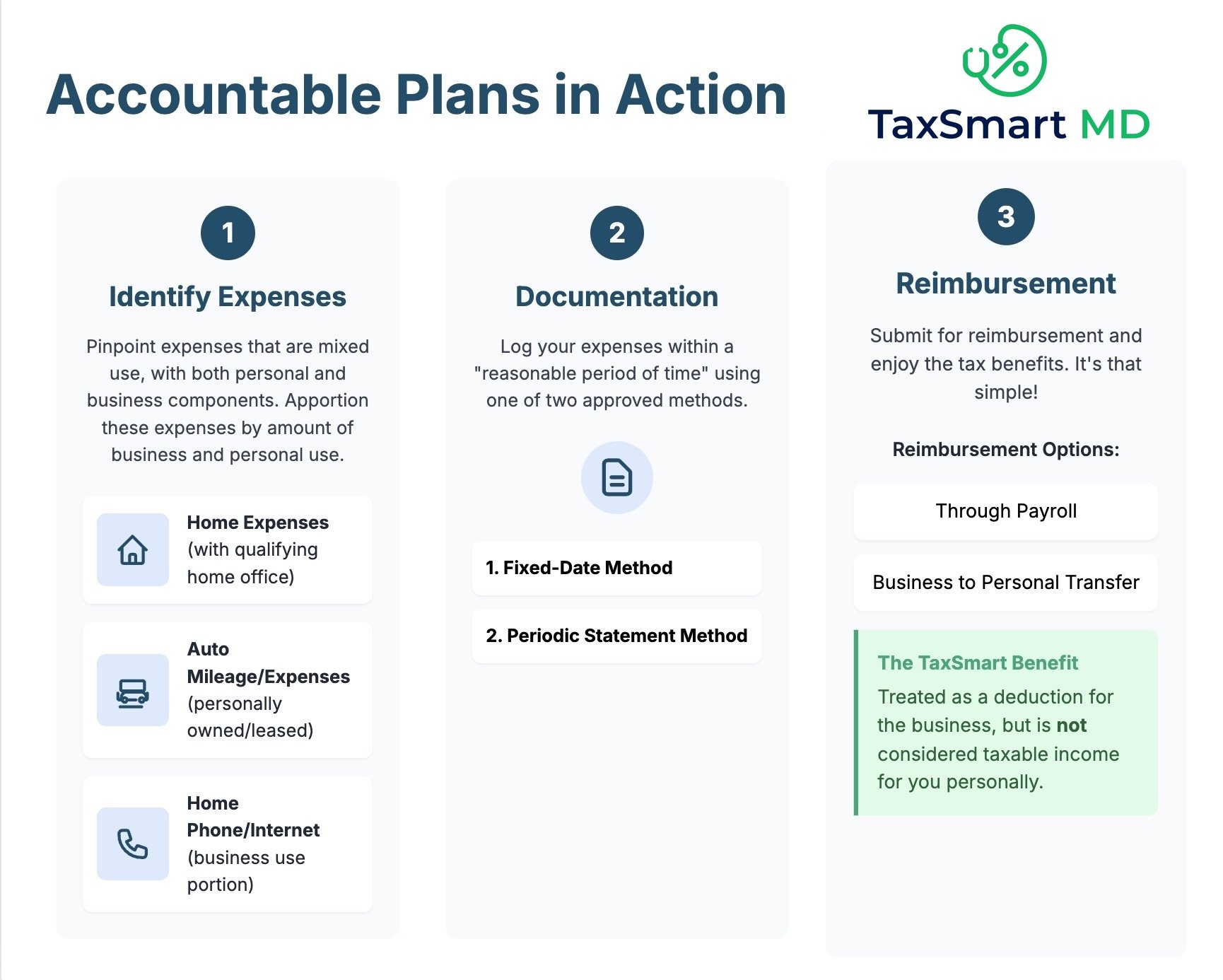
The Accountable Plan: The S-Corp Owner’s Secret Weapon for Tax-Free Reimbursements
If you run your business through an S Corporation, you’ve probably noticed that some expenses blur the line between “business” and “personal.”
That’s exactly where an accountable plan comes in — an IRS-approved system that lets your S Corp reimburse you for mixed-use business expenses without those reimbursements being treated as taxable income or wages.

Simplified vs. Regular Home Office Deduction for Sole Proprietors: How the Higher SALT Deduction Changes the Math
As a physician working from home, you have two methods to calculate your home office deduction: the simplified method and the actual expense method. While the simplified method appears straightforward on the surface, recent tax law changes—particularly the increase in SALT deduction limits—have shifted the calculation in ways that may surprise you.

When an S Corporation Isn’t the Right Prescription for Physicians
If you’ve spent more than ten minutes in a Facebook group for self-employed physicians, you’ve probably seen this refrain:
“Form an S Corporation — it’ll save you a fortune in taxes!”
Like most good tax advice, it’s sometimes true, but dangerously incomplete.

Eight Things You Probably Didn’t Know You Could Do With Your IRS Account - A Walkthrough
If you haven’t created an IRS account, or haven’t accessed it in a long time, there are many reasons why it is worth your time to log in and discover its features and functionality for yourself.

The Self-Employed Physicians’ Guide to the One Big Beautiful Bill, Part IV: What’s In It For Parents?
The costs of raising a family are a critical part of the financial picture for young couples and single parents. Considering that over 100 million households in the United States have a child under 18, it is hardly surprising that the One Big Beautiful Bill Act (OBBBA) contained several provisions that provide tax breaks to parents. If you have kids or are considering starting a family in the next few years, it’s worth knowing how you can make the most of these rules.

The Self-Employed Physicians’ Guide to the OBBBA Part III: Charitable Donations
In other words, the changes to the SALT deduction by themselves change how we look at charitable donations. What’s more, the OBBBA has introduced a couple of fairly minor changes to how charitable donations are deducted. Importantly, these take effect in 2026 (the change to the SALT deduction takes effect in 2025). Because they are both calculated on the same schedule of the tax return, and the total is compared with the standard deduction, there is significant interplay between them in a holistic tax plan that optimizes for 2025 and future years.

The Self-Employed Physicians’ Guide to the OBBBA Part II: Changes to the QBI Deduction
The new tax bill introduced some changes to the QBI deduction (also known as the Section 199a deduction). Taxpayers who work in service professions, such as medicine, have always been eligible for this deduction since it was enacted in the Tax Cuts and Jobs Act (TCJA).

The Self-Employed Physicians’ Guide to the OBBBA Part I: The New $40k SALT Cap Deduction
For most taxpayers, the largest tax obligation they pay at the state/local level is their state income tax.

…Ready for It? A New Tax Era for Kelce and Swift
Taylor Swift and Travis Kelce happily announced their engagement this week. If you are also considering a walk down the aisle, read on to learn how getting hitched can result in big changes in your tax return.

Navigating the Sunset: Expiring Energy Credits Under the One Big Beautiful Bill Act
The clean energy landscape underwent a major shift with the enactment of the "One Big Beautiful Bill Act" (OBBBA) on July 4, 2025….
